NEWS
From Textile Micro-Waste to 3D Filament for New Applications
The Scarabat project, led by Girbau Lab and Arpe Barcelona in collaboration with inèdit, aims to recover microplastics and lint generated during industrial washing and drying processes and transform them into new circular products.
When clothes are washed and dried, cotton lint and microplastics are released, often ending up in wastewater systems. Can these micro-residues be reused? This is the challenge addressed by Scarabat, an innovation project led by Arpe Barcelona and Girbau Lab with the objective of detecting, measuring and valorising the waste generated during industrial washing and drying processes.
The project also involves the Tèxtils.cat cluster and inèdit, with support from ACCIÓ. inèdit’s role is to analyse the carbon footprint of this pilot system for textile micro-waste valorisation.
The first wash: where most micro-waste is generated
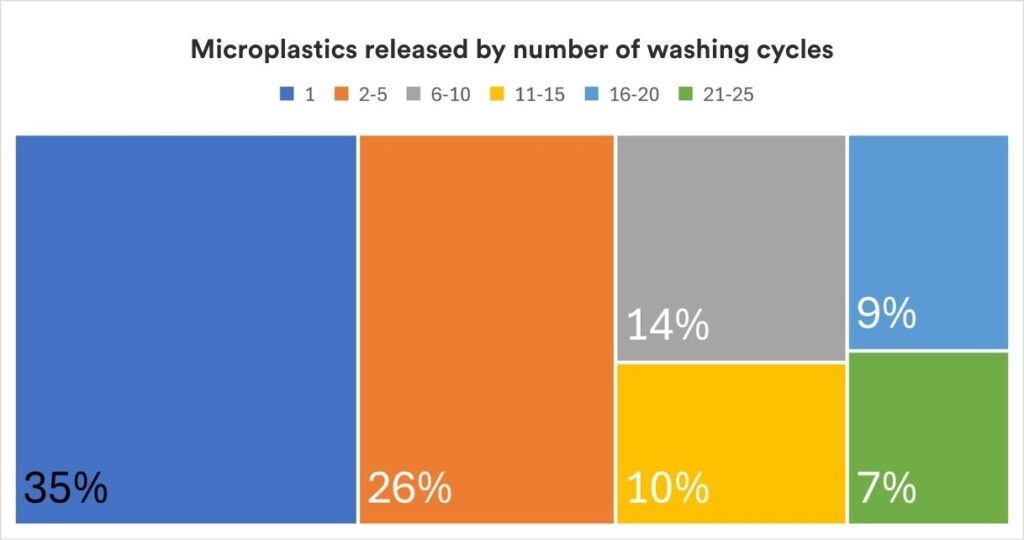
In the first phase of the project, Girbau’s Open Lab conducted tests to measure how many microplastics were released during 25 washing and drying cycles of Arpe Barcelona’s textile products.
The results show that 35% of total microplastics are released during the first wash, and 61% within the first five cycles
The results show that 35% of total microplastics are released during the first wash, and 61% within the first five cycles. Standard washing and drying programmes release a large initial amount of fibres that gradually decreases over time, whereas delicate programmes maintain a more stable emission rate.
Across the 25 washes, 4.9 grams of microplastics were quantified per kilogram of fabric, equivalent to an average of 0.196 g/kg per wash.
3D filaments for new products
The project is currently halfway through its research and development phase, and initial results are already emerging. One of the main achievements has been the development of a 3D printing filament made from recovered textile micro-waste.
“Early results show that what was previously considered a valueless waste stream can become a raw material for new uses and be integrated into product design and development,” state the project leaders.
This opens the door to integrating textile micro-waste into a truly circular economy, where materials remain in circulation and generate new opportunities.
The 3D filament allows the material to be approached from a new perspective: enabling agile experimentation, prototyping and testing, and exploring applications beyond the textile sector. Prototypes designed to be 3D printed with this filament are currently being developed.
In addition to validating the material’s technical feasibility, the project aims to explore:
- – Its aesthetic possibilities
- – Its behaviour in different shapes
- – Its potential integration into everyday objects
In the next phases, materials, applications and potential uses in Arpe Barcelona products will continue to be validated.
Main picture: Arpe Barcelona and Girbau Lab
With the support of: