NEWS
Hard-to-recycle waste finds its way into high-value interior design through the HABIT UP SPACES project
The project has demonstrated the potential of panels made from recovered post-consumer and industrial waste to create furniture and equipment for high-use spaces.
Can hard-to-recycle waste be transformed into high-value interior design solutions? This is the challenge addressed by HABIT UP SPACES, a project coordinated by AMBIT – Living Spaces Cluster and developed in collaboration with PLASTICPeople, CitySens Lab, Aleteo Insight and inèdit. The initiative has demonstrated the potential of panels made from recovered post-consumer and industrial waste in two real-life settings: La Casa Ecològica de La Fatarella and the coworking space in L’Ametlla de Mar, which houses one of inèdit’s offices.
The panels, developed by PLASTICPeople, have been the core element of the furniture and interior solutions specifically designed for these spaces. At La Casa Ecològica de La Fatarella, they were used to create a space for promoting and tasting wines from the DO Terra Alta appellation and other local products, including a large display shelving unit, a tasting table, stools, a mobile trolley and outdoor furniture. At the coworking space in L’Ametlla de Mar, the panels were integrated into several functional areas, demonstrating their ability to combine design, functionality and sustainability in high-use environments.
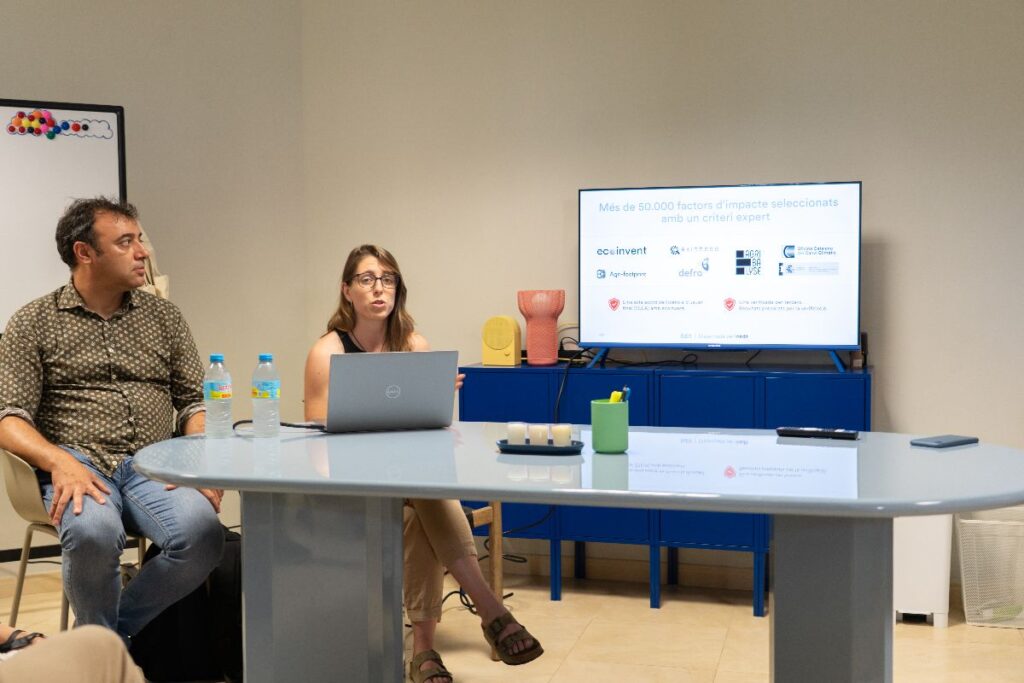
inèdit adapted its environmental assessment software, èdit, to evaluate the environmental performance of the new materials and products developed within the project. It also carried out the Life Cycle Assessment (LCA) of two of the products and developed the Environmental Product Declaration (EPD) for the FIRE CREAM panel.
inèdit’s contribution consisted of adapting its environmental assessment software, èdit, to evaluate the environmental performance of both the materials developed by PLASTICPeople and the products designed by CitySens Lab. In addition, inèdit carried out the Life Cycle Assessment (LCA) of the FIRE CREAM panel and the Motus planter module, manufactured by CitySens Lab using a FIRE CREAM panel, and developed the Environmental Product Declaration (EPD) for the FIRE CREAM material.
This work has strengthened the technical and environmental credentials of these new materials, provides objective information on their environmental performance and facilitates their specification in future interior design and contract projects.
The project’s results create new opportunities for material manufacturers, furniture companies, design studios, architects and interior designers to incorporate circular solutions into hotels, offices, commercial spaces, hospitality venues and public facilities. They also demonstrate that hard-to-recycle waste can be transformed into high-value materials for the interior design and contract sectors.
HABIT UP SPACES (ACE164/25/000024) is a project co-funded by ACCIÓ, the Agency for Business Competitiveness of the Government of Catalonia, under the 2025 grant programme for business projects carried out in nuclear transition areas, Line 4: Grants for cooperative projects (Resolution EMT/4485/2025 of 2 December).