
NEWS
REPORT
Sustainability gains weight in business decisions, according to the World Economic Forum
The first 'Chief Sustainability Officers’ Outlook', which captures the views of 103 sustainability leaders from companies around the world, also highlights the growing importance of climate change adaptation.
Sustainability is gaining ground in businesses and is increasingly linked to issues such as growth, resilience and value creation. This is one of the main conclusions of the first Chief Sustainability Officers’ Outlook, a World Economic Forum report that captures the views of 103 sustainability leaders from companies around the world on the evolution of the transition towards more sustainable business models.
The report finds that 63% of sustainability leaders expect global progress on sustainability to remain stable or accelerate over the next 12 months. Looking ahead to the next three years, the two leading accelerators they identify are a greater ability to demonstrate the business value of sustainability measures (64%) and more affordable and applicable technologies (56%).
From ambition to business integration
The findings point to an evolution in how sustainability is perceived within organisations: although regulatory compliance remains the predominant perspective — as indicated by 65% of CSOs — 41% say that sustainability is already perceived as a source of business growth or value.
41% of respondents say that sustainability is already perceived as a source of business growth or value.
In this context, the role of CSOs is also changing. Beyond defining sustainability strategies and targets, their role is increasingly focused on integrating environmental considerations into the decisions that determine how a company creates value — from investment and operations to product design, procurement and risk management.
AI: the opportunity and its impacts
Some 73% of CSOs expect artificial intelligence and other digital technologies to contribute to accelerating progress on sustainability, particularly through improved risk modelling, greater process and resource efficiency, and measurement and reporting. Technology, however, also has a footprint that needs to be managed. Regarding its main sustainability impacts, 77% of CSOs identify energy and resource intensity.
Adaptation gains prominence
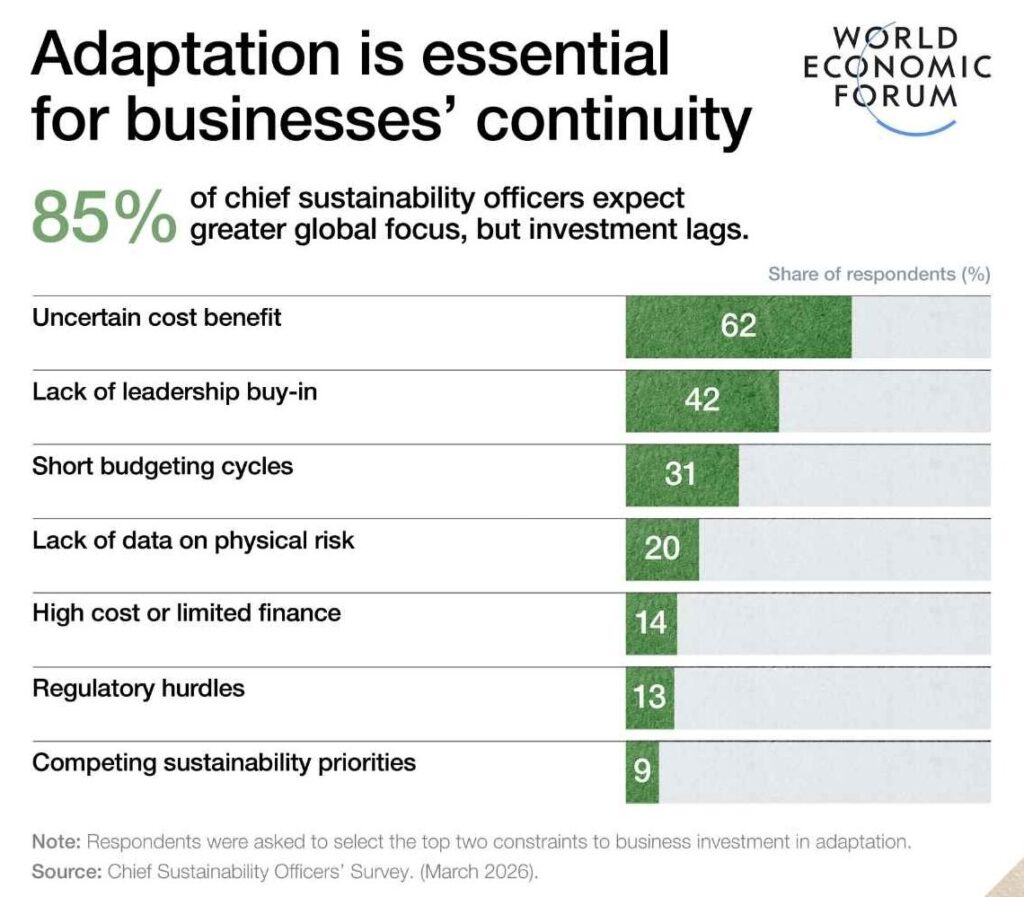
Another major shift highlighted by the report is the growing importance of climate change adaptation. Some 85% of CSOs expect it to become a greater global priority over the next three years, while 77% consider private investment to be critical to advancing adaptation.
However, a significant challenge remains: 62% identify uncertainty around calculating the relationship between costs and benefits as one of the main barriers to investing in adaptation. Unlike other investments, the value of resilience often materialises in losses that never occur. The report therefore points to the need for improved risk models and business cases that can make this value more visible.
Overall, the Chief Sustainability Officers’ Outlook points to a transition increasingly focused on execution and on integrating sustainability into business decisions. In a context of political, economic and geopolitical uncertainty, initiatives that can demonstrate how sustainability contributes to efficiency, innovation, resilience or the creation of new opportunities are more likely to become established.