
NEWS
REPORT
One-third of global economic value is lost due to inefficiencies in the linear model
The 'Circularity Gap Report 2026' quantifies for the first time the global economy’s value gap, which could be recovered through a circular model focused on retaining and extending the lifespan of materials.
Every year, materials worth €25.4 trillion are lost worldwide as a consequence of the linear economy, based on the take-make-use-dispose model. This loss is explained by inefficient use of resources, such as products being discarded too early and assets not being fully utilised. Considering that global Gross Domestic Product (GDP) is €82.6 trillion, this means that for every €3 of economic value created, €1 is lost. This is the first time the Circularity Gap Report 2026, produced by Circle Economy and Deloitte, has quantified this value gap.
An invisible loss in economic indicators
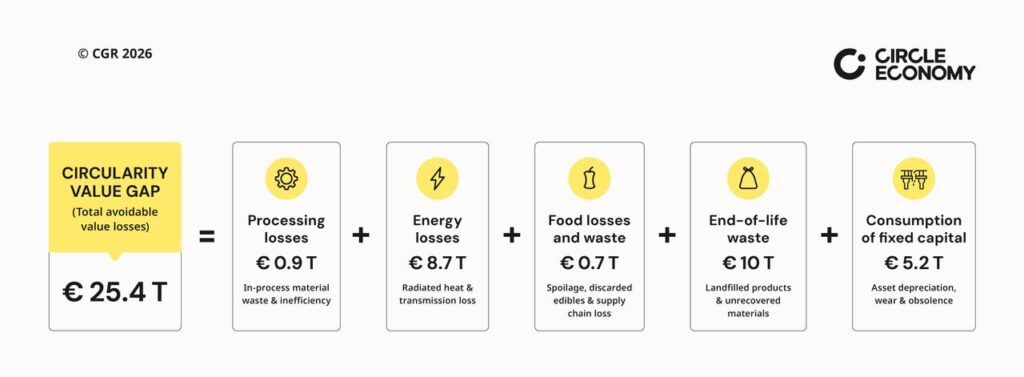
Conventional economic metrics do not account for the value loss caused by linearity. Indicators such as GDP measure economic activity but not value retention or erosion, such as resource depletion or waste generation. As a result, this structural loss remains invisible in economic decision-making. In this context, the value gap is defined in economic terms and expressed in prices, with GDP used as an approximation of total value generated. According to the report, incorporating this gap alongside GDP “provides a more realistic measure of net value creation, highlights the structural economic value lost due to linearity, and reveals the scale of the opportunity represented by circular strategies.”
The value gap highlights the economic value lost through linearity and demonstrates the opportunity represented by circular strategies.
The figure represents the avoidable economic value lost due to linear practices, which could be recovered through a circular economy model aimed at long-term value retention and recovery. Beyond direct economic costs, these losses also reflect often hidden environmental and social impacts, such as pollution, resource depletion, effects on human health, and reduced labour productivity. For the study’s authors, the value gap “is not just a measure of loss, but an opportunity to drive circular interventions that allow more value to be retained, reduce waste generation, and strengthen long-term prosperity.”
A structural loss requiring systemic change
The report highlights that this loss of value is structural and systemic, meaning it stems from the design of the linear economy itself rather than isolated inefficiencies.
To address the loss of value, a systemic redesign is needed in the way materials are sourced, used, retained, and circulated throughout the economy
Therefore, addressing it requires “a systemic redesign of how materials are sourced, used, retained, and circulated through the economy.” This involves transforming production and consumption systems and implementing structural changes across key sectors such as housing, food, mobility, and manufacturing. It also requires coordinated action across the entire value chain, as no single actor can tackle such a large-scale issue alone.
Beyond recycling: the potential of circularity
Circularity is fundamentally about reducing resource use and maximising value over time, not just recycling materials. In this regard, there is significant potential in recyclable materials that are currently not recovered, such as short-life consumer products, vehicles, and construction materials. According to the report, if all these flows were recycled, the circularity rate could increase by 25%.
However, a significant share of virgin and non-renewable materials is difficult to recycle or has low value. For this reason, it is essential to prioritise strategies that minimise waste and promote reuse, especially for high-value materials.
The Circularity Gap Report 2026 shows that while the use of recycled materials is increasing, the consumption of virgin materials is growing at a faster rate. Over the past fifty years, virgin material extraction has more than tripled, and without structural changes it could increase by a further 60% by 2060.